Bouldering in Montenegro: Outdoor Problems Guide
No rope, no harness — just you, a crash pad and a few metres of perfect limestone.
Bouldering strips climbing back to its essence. There's no rope, no belayer and no gear to fuss over — just a short, intense sequence of moves on a block close to the ground, with a crash pad below and a spotter ready to guide your landing. In Montenegro's high country, that simplicity meets some of the cleanest natural limestone in the Balkans, which makes it our favourite way to introduce someone to climbing for the very first time.
What bouldering is
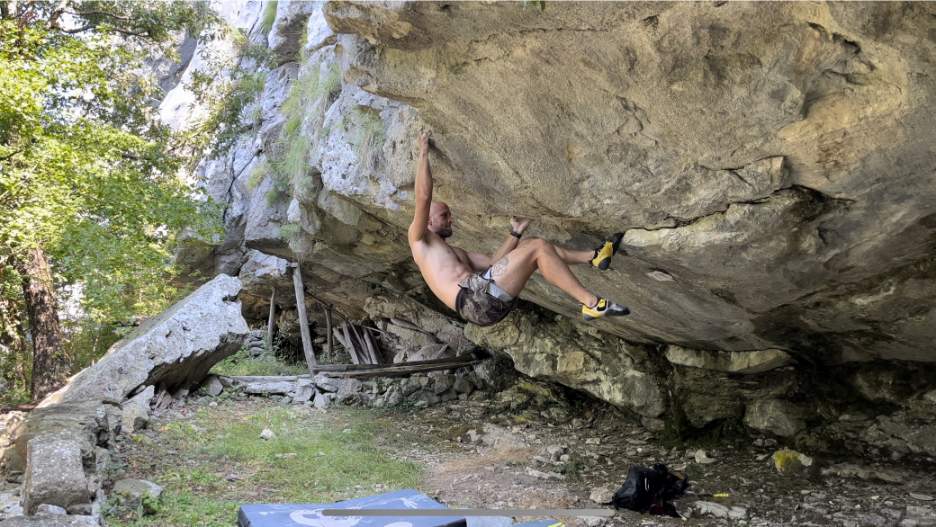
A boulder "problem" is a short climb, usually only a few metres high, that you attempt without a rope. Protection comes from portable foam crash pads laid on the ground and from a spotter who steadies you and directs you onto the pad if you come off. Because you're never far from the ground, the mental barrier that stops many people roping up simply isn't there — you try hard, you fall, you brush the chalk off and go again. It's social, low-commitment and surprisingly addictive.
Where to boulder: Durmitor and Prokletije
The two high mountain regions hold the best natural blocks. Durmitor, with its all-limestone crags ringed by the Tara, Piva and Komarnica canyons, scatters clean grey boulders through alpine meadows and forest — the setting alone is worth the trip. Prokletije, the wild range on the Albanian border built of pale Triassic and Cretaceous limestone, is the newer frontier, fast becoming Montenegro's most important alpine climbing destination. Both give you that rare combination of solid rock and total quiet.
The high altitude matters in summer: while the coast bakes, these blocks sit in cool mountain air, which is exactly when limestone friction is at its best. That makes bouldering the ideal warm-weather discipline when the lowland sport crags are too hot.
The bouldering scene here is young and still being written. Many lines have been developed only in recent years, which means the rock is clean, the holds aren't yet polished, and you're often the only party on a block. Montenegro's wider climbing identity is built on sport routes and big walls rather than dedicated boulder fields, so the bouldering has a pleasantly low-key, exploratory feel — closer to discovering problems than queuing for famous ones. For us as guides, that's part of the appeal: we get to share blocks that barely appear in any guidebook.
How bouldering compares to roped climbing
If you've only ever pictured climbing as ropes and harnesses, bouldering can be a revelation. There's no belaying to learn, no anchor to build and no faff between attempts, so a session is almost pure climbing time. The trade-off is intensity: problems are short but often physically demanding, packing hard moves into a few metres, which makes bouldering one of the best ways to build strength and movement skill quickly. Many climbers use it as training for the longer sport routes and multi-pitch walls elsewhere in the country — power on the boulders translates directly into confidence on the rope.
Why it's beginner-friendly
- Low to the ground — falls are short and onto soft pads.
- No technical rope skills — nothing to learn before you start climbing.
- Instant feedback — problems are short, so you cycle through attempts quickly and feel progress within a session.
- Great for groups and families — everyone takes turns, spots and cheers.
If you're bringing children or you're nervous about heights, our bouldering for beginners FAQ answers the practical questions before you commit.
Bouldering is the shortest path from "I've never climbed" to actually climbing — there's nothing between you and the rock but a few moves.
What to expect from a session
A guided session typically runs a half-day. We hike in to a cluster of blocks, lay out the pads and warm up on easy problems to wake up fingers and feet. From there your guide sets you challenges that build naturally — a slightly higher step here, a more committing move there — and spots every attempt. There's a lovely rhythm to it: try, fall, rest, watch a friend, try again. Because you're climbing in short bursts with breaks between, it never feels exhausting in the way a long roped pitch can, which is another reason it works so well for newcomers and mixed-ability groups. It pairs beautifully with a wider mountain day, whether that's hiking in Durmitor or building a longer climbing trip from our climbing hub.
Crash pads and what we bring
You don't need to own anything. On a guided session our team supplies the crash pads, climbing shoes and chalk, and our guides handle spotting and pad placement so your landing zone is always covered. All you bring is comfortable clothing and a willingness to fall off a few times. Every guided tour includes the technical safety equipment as standard.
Understanding the grades
Bouldering uses its own difficulty scales, but the principle is the same as roped climbing: easier problems have bigger holds and gentler angles, harder ones demand precise footwork, body tension and power. We always start a session well within your comfort zone to dial in technique, then build up. There's no pressure to chase a number — the goal is good movement and a smile. For the wider grade picture across all disciplines, see our climbing grades FAQ.
Key facts
- Location
- Durmitor and Prokletije natural limestone
- Difficulty
- Beginner-friendly; problems for all levels
- Season
- Summer is ideal — cool mountain friction
- Duration
- Half-day session
- Price
- from around €150 (group of 4)
Bouldering with a guide
The blocks are scattered through wild terrain and the best problems aren't signposted, so a guide turns a day of wandering into a day of climbing. Our certified guides know which sectors suit your level, carry the pads to the rock and coach your technique as you go. Book a guided bouldering session from around €150 for a group of four, set it inside a wider trip with our complete climbing guide, or message us on WhatsApp at +382 69 69 26 69 to find the right dates.