Via Ferrata for Beginners: Do You Need Experience?
The short answer is no — and here is exactly why the iron path is built to welcome people who have never climbed anything.
The most common message we get before a via ferrata is some version of: “I’ve never done anything like this — can I actually do it?” The honest answer, almost always, is yes. Via ferrata exists precisely so that people without climbing experience can spend time on terrain that used to belong only to mountaineers. You do not need skills you don’t have; you need a moderate level of fitness, a willingness to follow instructions, and the curiosity to clip in. Here is what to expect.
Why no experience is needed
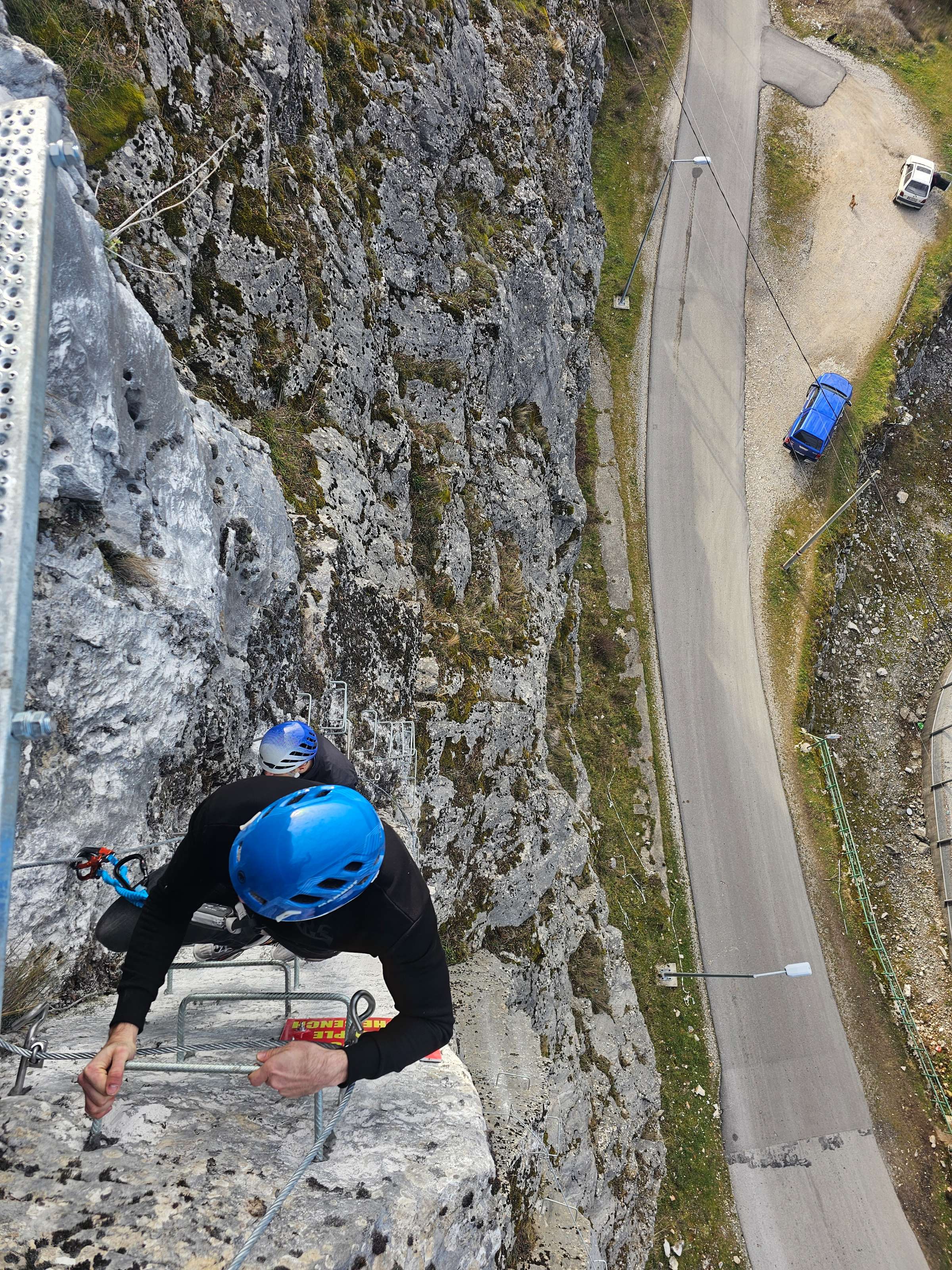
In rock climbing, the climber is responsible for the safety system — placing protection, managing ropes, reading the route. That responsibility is what makes climbing take years to learn. A via ferrata removes it entirely. The route is permanently equipped: a steel cable runs the whole length of the wall, bolted to the rock every few metres, with metal rungs and ladders where the natural holds give out.
Your connection to that cable is a simple, certified device called a via ferrata lanyard — a Y-shaped set with two carabiners and a built-in shock absorber. The rule you learn in five minutes is the only rule that matters: keep at least one carabiner on the cable at all times. To pass an anchor, you move one carabiner across, then the other. That is the entire technical skill. Our guides drill it on the ground until it is automatic before you leave it.
The fitness you actually need
Via ferrata is less about strength than steady effort. You are climbing rungs and pulling up gently for an hour or two, with breaks built in. If you can manage several flights of stairs without having to stop, you have enough.
- Legs do most of the work — you push up with your feet far more than you haul with your arms.
- Pace is yours — there is no clock, and a guide sets a rhythm the whole group can hold.
- The approach matters — a short uphill walk to the start is often the most tiring part, so trainers with grip help.
What about fear of heights?
Mild nervousness about exposure is completely normal — most first-timers feel it on the first few metres. What surprises them is how fast it fades. The constant, visible connection to the cable tells your body it is safe even when your eyes are arguing, and many people find the security lets them enjoy heights they could never have faced unroped.
The cable doesn’t pretend you aren’t high up. It quietly proves you are held — and that is usually enough.
The one honest exception is a severe, paralysing fear of heights, which a cable cannot talk you out of. If that is you, a different adventure will serve you better. For everyone else, the nerves are part of the reward.
What a first session actually feels like
Here is the honest sequence, because knowing it removes most of the worry. You arrive, meet your guide, and get fitted with a helmet and harness. Then comes the ground school: clipping and unclipping the two carabiners on a practice cable at waist height, over and over, until your hands do it without your brain. A short walk takes you to the start of the route — usually the most tiring part of the whole day. Then you step onto the rock.
The first few metres are where nerves peak. By the tenth metre most people have stopped thinking about the drop and started thinking about the next rung. The guide stays close, calls out where to put your feet, and keeps the pace comfortable. There is no race, no audience and no failure state — you simply move up, rest when you want, and look out at views you could never otherwise reach. People finish surprised by two things: how secure it felt, and how much they want to do it again.
What we provide — and what you bring
Everything technical comes from us, inspected to rescue-team standards: helmet, harness, the certified double-carabiner lanyard, and gloves for the steel. You bring sturdy trainers or approach shoes, water, sun protection and clothes you can move in. There is nothing to buy, rent or research in advance.
Which route to start with
For a true first via ferrata we point most people to the Orlina route at Slano Lake: short, sunny, family-friendly from age 12, and about an hour on the cable — long enough to feel the achievement, gentle enough to build confidence. Our Orlina guide describes it in full. Once you have a taste for it, the dramatic Via Ferrata Piva near Plužine is the natural next step.
Key facts
- Experience
- None required — full briefing provided
- Fitness
- Moderate; able to climb several flights of stairs
- Best first route
- Orlina at Slano Lake (family-friendly, ages 12+)
- Provided
- Helmet, harness, lanyard, gloves & guide
- Price
- from around €30
If you have read this far, you are almost certainly ready. Start with the bigger picture in our complete via ferrata guide, settle any last worries in the via ferrata experience FAQ, then message our certified guides and we will pick the right first route for you.